pythainlp.benchmarks
Introduction
The pythainlp.benchmarks module is a collection of utility functions designed for benchmarking tasks related to Thai Natural Language Processing (NLP). The module includes tools for word tokenization benchmarking and evaluation metrics for text generation tasks (BLEU and ROUGE).
Tokenization
Word tokenization is a fundamental task in NLP, and it plays a crucial role in various applications, such as text analysis and language processing. The pythainlp.benchmarks module offers a set of functions to assist in the benchmarking and evaluation of word tokenization methods.
Quality Evaluation
The quality of word tokenization can significantly impact the accuracy of downstream NLP tasks. To assess the quality of word tokenization, the module provides a qualitative evaluation using various metrics and techniques.
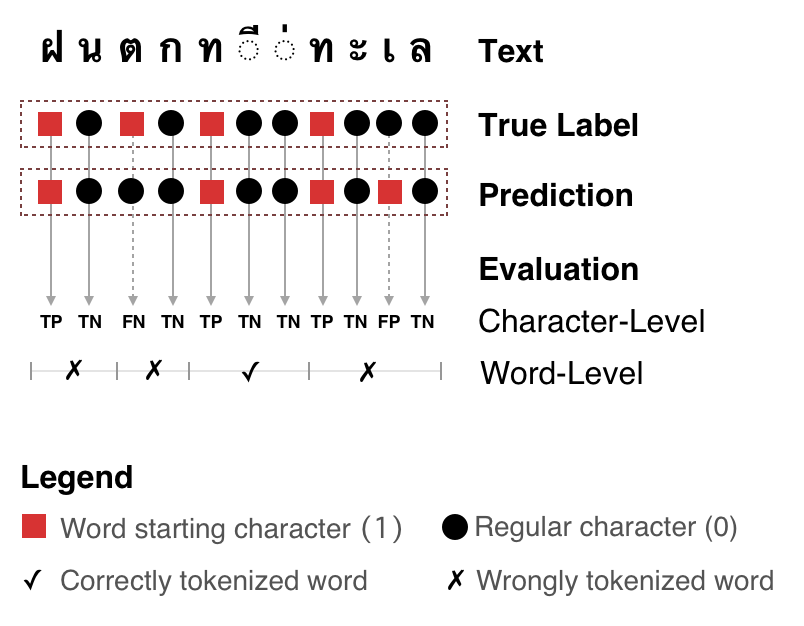
Qualitative evaluation of word tokenization.
Tokenization Functions
- pythainlp.benchmarks.word_tokenization.compute_stats(ref_sample: str, raw_sample: str) TokenizationStat[source]
Compute statistics for tokenization quality.
These statistics include:
Character-level - true positive, false positive, true negative, false negative
Word-level - precision, recall, and F1
Global - a
{0, 1}sequence indicating whether each word is tokenized correctly
- Parameters:
- Returns:
character-level, word-level, and global tokenization metrics
- Return type:
TokenizationStat
This function is used to compute various statistics and metrics related to word tokenization. It allows you to assess the performance of different tokenization methods.
- pythainlp.benchmarks.word_tokenization.benchmark(ref_samples: list[str], samples: list[str]) pd.DataFrame[source]
Benchmark tokenized samples against reference samples.
See
pythainlp.benchmarks.word_tokenization.compute_stats()for computed metrics.- Parameters:
- Returns:
dataframe with shape
len(samples) × len(metrics)- Return type:
pandas.DataFrame
The benchmark function facilitates the benchmarking of word tokenization methods. It provides an organized framework for evaluating and comparing the effectiveness of different tokenization tools.
- pythainlp.benchmarks.word_tokenization.preprocessing(txt: str, remove_space: bool = True) str[source]
Clean up text before performing evaluation.
- Parameters:
- Returns:
preprocessed text
- Return type:
Preprocessing is a crucial step in NLP tasks. The preprocessing function assists in preparing text data for tokenization, which is essential for accurate and consistent benchmarking.
- pythainlp.benchmarks.evaluate_word_tokenization(x_true: str | list[str] | list[list[str]], x_pred: str | list[str] | list[list[str]], sep: str = '') TokenizationScore[source]
Evaluate word tokenization at character and word levels.
Compute the character-level F1 score and the word-level F1 score between the reference (
x_true) and predicted (x_pred) segmentation. Ported from SEFR CUT (sefr_cut.evaluation).Supported input representations:
strings delimited by
"|", such as"สวัสดี|ประเทศไทย"single-element lists of delimited strings, such as
["สวัสดี|ประเทศไทย"]2D lists of strings, such as
[["สวัสดี|"], ["ประเทศไทย"]]1D lists of tokens with
sep="|", such as["สวัสดี", "ประเทศไทย"]
- Parameters:
- Returns:
tokenization score containing character score and word score
- Return type:
TokenizationScore
- Example:
from pythainlp.benchmarks import evaluate_word_tokenization

answer = "สวัสดี|ประเทศไทย"
pred = "สวัสดี|ประเทศ|ไทย"
char_score, word_score = evaluate_word_tokenization(answer, pred)
print(f"Char Score: {char_score}, Word Score: {word_score}")
# Char Score: 0.8, Word Score: 0.4
- pythainlp.benchmarks.word_eval_function(train: list[str], test: list[str]) float[source]
Compute the word-level F1 score for lists of words.
Calculate the F1 score based on word boundary span overlap between the reference (ground truth) words and the predicted words. Ported from SEFR CUT (
sefr_cut.evaluation).
- pythainlp.benchmarks.char_eval_function(y_true: list[int] | tuple[int, ...], y_pred: list[int] | tuple[int, ...]) float[source]
Compute the character-level F1 score for boundary indicators.
Calculate precision, recall, and binary F1 score for boundary (1) labels between reference and predicted character boundary sequences. Ported from SEFR CUT (
sefr_cut.evaluation).
Example for Word Tokenization Evaluation:
from pythainlp.benchmarks import evaluate_word_tokenization

answer = "สวัสดี|ประเทศไทย"
pred = "สวัสดี|ประเทศ|ไทย"
char_score, word_score = evaluate_word_tokenization(answer, pred)
print(f"Char Score: {char_score:.4f}, Word Score: {word_score:.4f}")
# Char Score: 0.8000, Word Score: 0.4000

# Also supports word tokens with sep='|'
char_score, word_score = evaluate_word_tokenization(
    ["สวัสดี", "ประเทศไทย"], ["สวัสดี", "ประเทศ", "ไทย"], sep="|"
)
Evaluation Metrics
The module provides pure Python implementations of common evaluation metrics (BLEU and ROUGE) that automatically handle Thai text tokenization. These metrics are essential for evaluating machine translation, text summarization, and other text generation tasks.
BLEU Score
BLEU (Bilingual Evaluation Understudy) is a metric for evaluating the quality of machine-translated text. It compares the generated text against one or more reference translations by measuring n-gram precision with a brevity penalty.
- pythainlp.benchmarks.bleu_score(references: list[str] | list[list[str]], hypotheses: list[str], tokenize: str = 'newmm', lowercase: bool = False, max_ngram: int = 4, smooth: bool = True) BleuScore[source]
Calculate BLEU score for Thai text with automatic tokenization.
This is a pure Python implementation of BLEU (Bilingual Evaluation Understudy) metric that automatically tokenizes Thai text using PyThaiNLP before calculating the score.
- Parameters:
references (Union[list[str], list[list[str]]]) – reference translations, either a list of strings (one reference per hypothesis) or a list of lists of strings (multiple references per hypothesis)
hypotheses (list[str]) – hypothesis translations to evaluate
tokenize (str) – engine to tokenize text with. See
pythainlp.tokenize.word_tokenize()for available engines (default is"newmm")lowercase (bool) – lowercase text before evaluation (default is False)
max_ngram (int) – maximum n-gram order (default is 4)
smooth (bool) – smooth zero counts (default is True)
- Returns:
BleuScoretyped dict with'bleu','precisions','bp','length_ratio','hyp_length', and'ref_length'.'precisions'islist[float];'hyp_length'and'ref_length'areint; all other values arefloat.- Return type:
BleuScore
- Raises:
ValueError – if the number of references and the number of hypotheses differ
- Example:
>>> from pythainlp.benchmarks import bleu_score
>>> references = ["สวัสดีครับ วันนี้อากาศดีมาก"]
>>> hypotheses = ["สวัสดีค่ะ วันนี้อากาศดี"]
>>> score = bleu_score(references, hypotheses)
>>> print(f"BLEU score: {score['bleu']:.2f}")
BLEU score: 28.12
>>> # Multiple references per hypothesis
>>> references = [
...     ["สวัสดีครับ", "สวัสดีค่ะ"],  # two refs for first hypothesis
...     ["ลาก่อนครับ", "ลาก่อนค่ะ"],  # two refs for second hypothesis
... ]
>>> hypotheses = ["สวัสดี", "ลาก่อน"]
>>> score = bleu_score(references, hypotheses)
Example:
from pythainlp.benchmarks import bleu_score

# Single reference
references = ["สวัสดีครับ วันนี้อากาศดีมาก"]
hypotheses = ["สวัสดีค่ะ วันนี้อากาศดี"]
score = bleu_score(references, hypotheses)
print(f"BLEU: {score['bleu']:.2f}")

# Multiple references per hypothesis
references = [
    ["สวัสดีครับ", "สวัสดีค่ะ"],
    ["ลาก่อนครับ", "ลาก่อนค่ะ"],
]
hypotheses = ["สวัสดี", "ลาก่อน"]
score = bleu_score(references, hypotheses)
print(f"BLEU: {score['bleu']:.2f}")
ROUGE Score
ROUGE (Recall-Oriented Understudy for Gisting Evaluation) is a set of metrics for evaluating automatic summarization and machine translation. It measures the overlap between the generated text and reference text(s).
- pythainlp.benchmarks.rouge_score(reference: str, hypothesis: str, tokenize: str = 'newmm', rouge_types: list[str] | None = None) dict[str, RougeScore][source]
Calculate ROUGE scores for Thai text with automatic tokenization.
This is a pure Python implementation of ROUGE (Recall-Oriented Understudy for Gisting Evaluation) metric that automatically tokenizes Thai text using PyThaiNLP.
Supported ROUGE types:
rouge1 - unigram-based scoring
rouge2 - bigram-based scoring
rougeL - longest common subsequence-based scoring
- Parameters:
reference (str) – reference text
hypothesis (str) – hypothesis text to evaluate
tokenize (str) – engine to tokenize text with. See
pythainlp.tokenize.word_tokenize()for available engines (default is"newmm")rouge_types (Optional[list[str]]) – ROUGE types to calculate (default is
["rouge1", "rouge2", "rougeL"])
- Returns:
dictionary mapping each ROUGE type to a
RougeScoretyped dict with'precision','recall', and'fmeasure'keys- Return type:
- Example:
>>> from pythainlp.benchmarks import rouge_score
>>> reference = "สวัสดีครับ วันนี้อากาศดีมาก"
>>> hypothesis = "สวัสดีค่ะ วันนี้อากาศดี"
>>> scores = rouge_score(reference, hypothesis)
>>> print(f"ROUGE-1 F-measure: {scores['rouge1']['fmeasure']:.4f}")
ROUGE-1 F-measure: 0.6000
>>> print(f"ROUGE-2 F-measure: {scores['rouge2']['fmeasure']:.4f}")
ROUGE-2 F-measure: 0.2500
>>> print(f"ROUGE-L F-measure: {scores['rougeL']['fmeasure']:.4f}")
ROUGE-L F-measure: 0.6000
Example:
from pythainlp.benchmarks import rouge_score

reference = "สวัสดีครับ วันนี้อากาศดีมาก"
hypothesis = "สวัสดีค่ะ วันนี้อากาศดี"
scores = rouge_score(reference, hypothesis)

for rouge_type, (precision, recall, fmeasure) in scores.items():
    print(f"{rouge_type}: P={precision:.4f}, R={recall:.4f}, F={fmeasure:.4f}")
Word Error Rate (WER)
Word Error Rate is a common metric for evaluating speech recognition and machine translation systems. It measures the minimum number of word-level edits (insertions, deletions, substitutions) needed to transform the hypothesis into the reference.
- pythainlp.benchmarks.word_error_rate(reference: str, hypothesis: str, tokenize: str = 'newmm') float[source]
Calculate word error rate (WER) for Thai text.
Word error rate is a common metric for evaluating speech recognition and machine translation systems. It measures the minimum number of word-level edits (insertions, deletions, substitutions) needed to transform the hypothesis into the reference, normalized by the reference length.
WER = (S + D + I) / N
where:
S = number of substitutions
D = number of deletions
I = number of insertions
N = number of words in the reference
- Parameters:
- Returns:
word error rate (0.0 is perfect, above 1.0 is very poor)
- Return type:
- Example:
>>> from pythainlp.benchmarks import word_error_rate
>>> reference = "สวัสดีครับ วันนี้อากาศดีมาก"
>>> hypothesis = "สวัสดีค่ะ วันนี้อากาศดี"
>>> wer = word_error_rate(reference, hypothesis)
>>> print(f"WER: {wer:.4f}")
WER: 0.4000
Example:
from pythainlp.benchmarks import word_error_rate

reference = "สวัสดีครับ วันนี้อากาศดีมาก"
hypothesis = "สวัสดีค่ะ วันนี้อากาศดี"
wer = word_error_rate(reference, hypothesis)
print(f"WER: {wer:.4f}")
Character Error Rate (CER)
Character Error Rate is a metric for evaluating speech recognition and optical character recognition (OCR) systems. It measures the minimum number of character-level edits (insertions, deletions, substitutions) needed to transform the hypothesis into the reference.
- pythainlp.benchmarks.character_error_rate(reference: str, hypothesis: str) float[source]
Calculate character error rate (CER) for Thai text.
Character error rate is a metric for evaluating speech recognition and optical character recognition (OCR) systems. It measures the minimum number of character-level edits (insertions, deletions, substitutions) needed to transform the hypothesis into the reference, normalized by the reference length.
CER = (S + D + I) / N
where:
S = number of substitutions
D = number of deletions
I = number of insertions
N = number of characters in the reference
- Parameters:
- Returns:
character error rate (0.0 is perfect, above 1.0 is very poor)
- Return type:
- Example:
>>> from pythainlp.benchmarks import character_error_rate
>>> reference = "สวัสดีครับ"
>>> hypothesis = "สวัสดีค่ะ"
>>> cer = character_error_rate(reference, hypothesis)
>>> print(f"CER: {cer:.4f}")
CER: 0.3000
Example:
from pythainlp.benchmarks import character_error_rate

reference = "สวัสดีครับ"
hypothesis = "สวัสดีค่ะ"
cer = character_error_rate(reference, hypothesis)
print(f"CER: {cer:.4f}")
Usage
To make use of these benchmarking functions, you can follow the provided examples and guidelines in the official PyThaiNLP documentation. These tools are invaluable for researchers, developers, and anyone interested in improving and evaluating Thai word tokenization methods and text generation systems.